Showing posts with label Automation. Show all posts

Monday, September 26, 2011

Seven Effective uses of Technology in Business

rocketmanThis is Part 2 in a series about the role of technology in business improvement. In Part 1 we explored Five Ways to Incorrectly Use Technology.

Organizations can experience significant benefits applying technology in scenarios where:

  • technology can be a catalyst for innovating around a process.
  • the majority of the perceived process waste has been removed.
  • the ability to improve the process without technology has reached its threshold.
  • technology is better suited for poka-yoke, such as eliminating math errors or guiding complicated work flows.
  • the risks of injury or danger to employees can be reduced or eliminated. Examples are un-manned military drones replacing pilots in hostile areas or using robots in automotive paint spray booths.
  • the mechanical burden of maintaining the process using manual methods becomes a hindrance to productivity.
  • information or collaboration needs to be shared across geographic boundaries.

photo credit: jurvetson / CC BY 2.0

Tuesday, May 11, 2010

Right-sizing the Vacuum – a Lean Machine

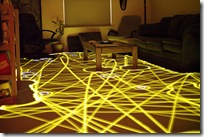
roomba time-lapse trail

Floors and carpets don’t wait to get dirty until the day you vacuum. They accumulate dirt, lint, and other debris every day at a reasonably constant rate. If you ran the vacuum daily the vacuum wouldn’t need to be as powerful or have a reservoir that holds a gallon of gunk.

But who has the time to vacuum every day? If the sweeping was automated by using a device like the Roomba, daily cleaning can become a reality.

Examples of Lean can be found in the most unusual places, like cleaning machines and processes.

5S Concepts

  • keep the most frequently used tools closest to the work
  • keep the area clean and free of slip and trip hazards – frequent sweeping and keeping wires and trip hazards off the floor
  • everything has a place – the charging station is like a shadow board

Lean Concepts

  • Quick changeover – traditional vacuums tend to be heavy and take up space so they are often put away in a closet or laundry room and require dragging out and winding/unwinding of long cords; smaller size can get in tight spaces without using optional attachments or moving furniture
  • right-sizing: enclosure, motor, debris reservoir, power source (battery) sized for the more frequent, but lighter workload
  • poka yoke – sensors to protect from injuring pets and children, tumbling off the stairs; virtual walls to restrict the cleaning area; works in the dark; dirt sensing; auto-charging of the battery
  • standardized work – Roomba follows a navigational algorithm; standard method to determine the necessity of special spot cleaning mode; some models have automatic schedulers
  • no defects passed to upstream processes – special spot cleaning mode enabled immediately when excessive dirt is detected

If the floors are vacuumed/swept daily, there is no worry about dust bunnies when a friend or neighbor stops by unannounced.

As the path highlighted in the above image shows, the Roomba might not be as efficient in the travelling path as a human operator, but the important thing is that all the surfaces are effortlessly covered at an acceptable quality within the Takt time.

Automated vacuum robots are not for everyone or everywhere, but they present a compelling argument for consideration. If nothing else, it might give you an excuse to justify buying that nifty robot you’ve had your eyes on.

Automated robots are gaining in popularity for other tasks as well:

  • mopping
  • garage sweeping
  • gutter cleaning
  • lawn mowing

Additional Benefit

They can keep the family pet company while you’re away.

Where do you see other interesting or unconventional examples of Lean concepts being applied? Comments welcome.

Disclaimer: I don’t own any iRobot products or receive any financial or other benefits from them.

Photo attribution

http://www.flickr.com/photos/13963375@N00 / CC BY-SA 2.0

Thursday, June 11, 2009

Coke Meets ‘The Jetsons’ with new Robodispenser

Coca-Cola recently announced a revolutionary new soda dispenser they will soon pilot in selected areas. See a great comprehensive article in the June 8, 2009 issue of Information Week magazine. It is a significant announcement for many reasons.

  • The Freestyle “Fountain” dispenses over 100 different beverages (sodas, juices, teas, and flavored waters) using thirty highly concentrated flavor cartridges.
  • The system uses RFID tags on the flavor cartridges to track inventory
  • The dispenser communicates with a central Corporate point-of-sale system and data warehouse via a dedicated wireless network recording quantity, types, time, and location of drinks sold

Customer Value

  • More choices
  • Special offers

Retailer Value

  • Inventory optimization
  • 100 choices in the same footprint as an eight to 12 drink dispenser
  • Information about sales patterns that can be used to provide special offers to the customers
  • Easier ordering process with recommendations based on ten day moving average of sales, cartridge inventory, and dispenser inventory.
  • Access to a portal with visibility to the consumption data and statistics that can be sliced and diced by cartridge, drink, dispenser, hour, day, week, etc.

Value to Coca-Cola

  • Faster, lower cost new product Research & Development, Market Research, product piloting and production rollout
  • Remotely adjust beverage formulas
  • Better understanding of regional customer preferences
  • First to market; four years in development
  • Better data to align supply with demand for Sales and Operations planning
  • Competitive advantage with offer of high retailer and customer value

When Information Technology is applied effectively in close cooperation with Business Operations, improvement initiatives offer opportunities for significant gains for all parties involved from the supply chain to the customer.